



CfIA News
CFIA obtained Remote/Home Office Cybersecurity Preparedness Training Certification
The Center for Information Assurance (CfIA) recently obtained certification for a web-based training course developed for the National Cybersecurity Preparedness Consortium, which is funded by the DHS/FEMA Homeland Security National Training Program. The Remote Home/Office Cybersecurity Preparedness Training course is offered at no cost, and a certificate of completion can be obtained for professional certification continuing education units. Additional course information can be found at Cyber Readiness Center.
National Cybersecurity Awareness Month
Cybersecurity is important every day, but during this annual National Cybersecurity Awareness month, it is especially important to be reminded that cybersecurity is everyone’s responsibility. Did you know that end users are the weakest link in an organization’s cybersecurity posture? Ask yourself, do you and your colleagues know the most basic of things that all users should know in this environment? At a minimum, all users should know:
- How to identify potential schemes and/or attacks
- What to do to protect their organization’s data and their own personal information
- Who to contact within their organization should they observe unusual activity
- Who to contact if they become a victim of a cyber attack
The key to strengthening that weakest link is cybersecurity training. FEMA and the National Cybersecurity Preparedness Consortium (NCPC) offer a number of courses designed to help end-users protect themselves against cyber crime. You can find more information about the NCPC here.
A Virtual Workshop on AI Enhanced IoT Security
North Carolina A&T State University is hosting a workshop entitled "A Virtual Workshop on AI Enhanced IoT Security." The workshop is sponsored by the Cybersecurity Education in Critical Infrastructure Protection (CECIP) grant awarded to the consortium led by The University of Memphis CfIA. The event is scheduled for October 27, 2023. You can register for the virtual event here.
Cybersecurity Education for Critical Infrastructure Protection Workshop
The Citadel College is hosting an in-person workshop entitled "Cybersecurity Education for Critical Infrastructure Protection" in Charleston, SC. The workshop is sponsored by the CECIP grant awarded to the 4-team consortium led by The University of Memphis CfIA. The event is scheduled for October 19 - 20, 2023. You can register for the event here.
Course Pilot Testers Needed
The University of Memphis Center for Information Assurance (CfIA) is seeking pilot-testers
for its "End-User Security and Privacy (ESP)" course. Your assistance in this matter is greatly appreciated. The course can be
accessed at "actonline.memphis.edu".
Cyber Resilient EV Charging Station & Critical Infrastructure Workshop
The Center for Information Assurance (CfIA) in the Department of Computer Science at the University of Memphis is excited to host the Cyber Resilient EV Charging Station and Critical Infrastructure Workshop in conjunction with the Electrical Engineering/Computer Engineering Department. The date for the event is Friday August 25, 2023. Please see the Workshop Final Agenda. A Summary Report of the Event can be found by clicking the link.
For more information, call 901.678.2225 or email: mhali@memphis.edu
2023 Cyber Ambassador Tech Camp
The Center for Information Assurance (CfIA) in the Department of Computer Science at the University of Memphis is excited to host 2023 Cyber Ambassadors Tech Camp. This year’s Cyber Ambassadors Tech Camp will offer high school students a distinctive learning experience focused on fundamental cybersecurity principles and ethics, while raising cybersecurity awareness through a range of autonomous R/C car projects on various types of cybersecurity attack scenarios including password hacking, buffer overflow attack, and man-in-the-middle attack.
For more information, call 901.678.4271 or email: mwon@memphis.edu
UofM CyberCorps: SFS (Scholarship for Service)
UofM CyberCorps: SFS (Scholarship for Service) has awarded four (4) more students
the CyberCorps Scholarship for the Spring 2023 term. The scholarship application is
on the 'Tiger Scholarship Manager' and will be open in February for the Fall 2023
cohort. It will be awarded once every year thereafter.
For additional info, please stop by the CFIA office to pick up a flyer (Dunn #209)
or email us at cfia@memphis.edu.
NICE Conference & Expo 2023: Now Accepting Student Sponsorship Applications
We are happy to announce that we will be providing sponsorships to a select few higher
education students that will cover their registration cost, travel, hotel accommodation
and some meals. This opportunity will provide students with the ability to attend
the conference with the goal of gaining new knowledge, sharing their work, and engaging
with cybersecurity practitioners from academia, government, and industry.
The selection is competitive and only a small number of students will be accepted.
Students must be prepared to submit their basic personal information, an application
essay, resume, and a letter of recommendation. Students will then be selected by our
2023 NICE Conference Washington State Academic Consortium Committee based on the criteria
that was requested. The student submission deadline is February 23, 2023. Learn more about the application process and how to apply.
Course Pilot Testers Needed
The University of Memphis Center for Information Assurance (CfIA) is seeking pilot-testers
for its "Cybersecurity Preparedness for the Remote Home Office (RHO)" course. Your assistance in this matter is greatly appreciated. The course can be
accessed through Act-online.
12th Annual Mid-South Cybersecurity Summit
This annual summit, organized by the Center for Information Assurance (CfIA), aims
to provide a platform for companies and institutions in the Mid-South Region to learn,
discuss, and exchange knowledges and technologies about Cyber Security. The event
will be held on November 4, 2022 at the University of Memphis - FedEx Institute of
Technology. The theme this year is "When AI meets Cybersecurity." Click here to register.
2022 CSforALL Summit - Student Volunteers Needed
The 2022 CSforALL Summit is scheduled for October 19-21, 2022. It will be held at
The Guest House at Graceland. Student volunteers are needed to help make the event
successful. Volunteer individuals will have the opportunity to make professional contacts
and learn from CS and STEM organizations. Additionally, they will receive a CSforALL
Summit Volunteer T-Shirt, food, and refreshments among other things. If you're interested,
please register via the link associated with the 2022 CSforALL SUMMIT VOLUNTEERS flyer.
2023 DoD Cyber Scholarship Program (CySP)
The application portal for the 2023 DoD Cyber Scholarship Program will be opening
on November 1, 2022. The Department of Defense is seeking rising junior and senior
undergraduate (third and fourth year) and graduate/doctoral students who are interested
in full-ride scholarships for concentrated studies in information assurance. Students
selected for the program will receive full scholarships. This requires the student
to agree to serve one year of service to the DoD, upon graduation, for each year of
the scholarship received, in addition to the internship.
IEEE DAY - Distinguished Lecture - Dipankar Dasgupta
Dr. Dasgupta is scheduled to lecture on October 4, 2022 @ 9:00AM CDT. This talk will
discuss some important use of AI in search, optimization, prediction, and discovery;
how algorithmic bias can impact decisions; how AI can play dual-role and can be applied
in many ways with varying intent. I will also exhibit use cases on “Defensive AI and
Offensive AI”, and in designing “Digital Twin”. Finally, I will argue that with the
significant business benefits of using AI/ML techniques, there exist possibilities
of misuse/abuse or inappropriate use of such techniques. So, regulations such as Algorithmic
Accountability Act. become essential for AI-based developers to take responsibility
of their products and services. Registration.
IoT Security Workshop
The University of Memphis Center for Information Assurance (CfIA) and North Carolina
A&T State University are collaborating to produce a hybrid workshop on IoT Security.
The workshop will be hosted on the campus of NC A&T State University on September
23, 2022, at 9AM – 2:30PM EST. Participants can attend in-person or virtually. Please
check the “Events” schedule for the registration link.
The 6th annual National Cybersecurity Virtual Career Fair
The 6th annual National Cybersecurity Virtual Career Fair, sponsored by the National
Cybersecurity Training and Education (NCyTE) Center and the CAE in Cybersecurity Community,
is right around the corner! The career fair brings together students and alumni from
over 380 institutions across the Nation designated as Centers of Academic Excellence
in Cybersecurity with employers offering apprenticeships, internships, and full-time
employment. This year, the National Cybersecurity Virtual Career Fair will take place
on September 16th, 2022, from 9am to 1pm PT.
Each year, the number of undergraduate and graduate students and alumni participating
in this event continues to grow. Participants come from a variety of disciplines,
including cybersecurity, national security studies, computer science, engineering,
math, physics, and project management. Students from CAEs in Research (CAE-R), Cyber
Defense (CAE-CD), and Cyber Operations (CAE-CO) are invited to participate for FREE.
UofM’s Dr. Dipankar Dasgupta Works with NCPC to Create Cybersecurity Legislation
New law authorizes DHS to increase response efforts nationwide
The Department of Homeland Security (DHS) can now work with the National Cybersecurity
Preparedness Consortium (NCPC) to increase its cybersecurity preparedness and incident
response initiatives nationwide after Congress adopted and sent the National Cybersecurity
Preparedness Consortium Act (NCPC) to President Biden to sign into law.
NCPC efforts at the UofM are being led by Dr. Dipankar Dasgupta (Computer Science), Directors of the Center for Information Assurance (CfIA). The bill was first introduced
in the Senate in March 2021. The Senate agreed to House amendments by unanimous consent
April 7, 2022, and was sent to the President on May 3. President Biden signed the
NCPC Act into law on May 12, 2022. For more information on this legislation, contact
Dasgupta at ddasgupt@memphis.edu.
University of Memphis Recognized as a National Center of Excellence in Cyber Defense
NSA and U.S Department of Defense designation awarded through the 2027 academic year
The University of Memphis has been designated as a National Center of Academic Excellence
in Cyber Defense (CAE-CD) through the 2027 academic year. Official letters of notification
were sent to the Honorable Bill Lee, Governor of the State of Tennessee, members of
Congress, appropriate Congressional Committees, as well as to University of Memphis
leadership. As part of this designation, the UofM will be listed as a CAE-CD on the
CAE Institution Map and listed on the CAE Community website. CAE-designated institutions must complete
the validation of a Program of Study (PoS), which is a series of courses and experiences
a student can reasonably accomplish in the course of attaining a degree or completing
a certificate.
Dr. Dipankar Dasgupta, Hill Professor in Cybersecurity, and director for the Center for Information Assurance
(CfIA), led this effort for recertification, with the help of Dr. Kan Yang, assistant professor (Computer Science), and Dr. Myounggyu Won, assistant professor (Computer Science), as the associate directors of the center.
Cybersecurity Research / Training Workshop (In-Person) Funded by Navy ROTC
The University of Memphis, The Center for Information Assurance, and The ROTC Research
Students are conducting an in-person (hands-on activities) Cybersecurity Research
/ Training Workshop on June 21, 2022, from 09:00 AM - 02:00 PM Central Time (U.S.
and Canada). Location: University of Memphis - FedEx Institute of Technology (FIT)
- Fishbowl 203/205. The workshop's topic is “The Issues and Topics concerning Operational
Cybersecurity.” Please reach out to Chinita Holmes at csholmes@memphis.edu to reserve your seat.
Cyber Tigers Guest Speaker - Scott Augenbaum, former FBI Cyber Agent
The University of Memphis, The Center for Information Assurance, and the Cyber Tigers
welcome Scott Augenbaum by Zoom conference Thursday April 28th at 1pm. He is a former
FBI Cyber Agent and now professionally speaks across the country on cyber threats.
Cybersecurity Research / Training Workshop Funded by Navy ROTC
The University of Memphis, The Center for Information Assurance, and The ROTC Research
Students are conducting Cybersecurity Research / Training Workshop on April 23, 2022,
from 09:00 AM - 01:00 PM Central Time (U.S. and Canada). The workshop's topic is “The
Issues and Topics concerning Operational Cybersecurity.” Please register here in advance for this webinar. After registering, you will receive a confirmation email
containing information about joining the webinar.
Jack Voltaic Conference Series: Cyber Resiliency for Critical Infrastructure
Members of the project team for the Cybersecurity Education in Critical Infrastructure
Protection will be participating in a Panel Discussion at the Jack Voltaic Conference
Series on Thursday February 24th. The conference is scheduled to be held at The Citadel
- Holliday Alumni Center in Charleston, SC. A more detailed itinerary and registration can be found here.
Cybersecurity Training Grant Research Opportunities
A joint effort of Engineering Technology and Computer Science has been awarded a grant
from the Office of Naval Research to build a team for opportunities of existing Undergraduate
students capable of effectively conducting research studies in the area of cybersecurity,
pairing a variety of skills with organization and leadership. Read More >>
2022-23 DoD Cyber Scholarship Program (CySP)
The Department of Defense is seeking rising junior and senior undergraduate (third
and fourth year) and graduate/doctoral students who are interested in full-ride scholarships
for concentrated studies in information assurance. Students selected for the program
will receive full scholarships. This requires the student to agree to serve one year
of service to the DoD, upon graduation, for each year of the scholarship received,
in addition to the internship ... Read More >>
Center for Information Assurance Works to Expand Training Opportunities Under FEMA
A FEMA Continuing Training Grant was awarded to the National Cybersecurity Preparedness
Consortium of which the University of Memphis is a member. The grant lead is the University
of Arkansas Criminal Justice Institute with the University of Memphis as a sub-awardee
($600,000). Dr. Dipankar Dasgupta (Computer Science) will lead the grant to develop
new cybersecurity .... Read More>>
Resilience Week 2021 (October 18-21 Virtual): Transforming the resilience of critical infrastructure systems and communities
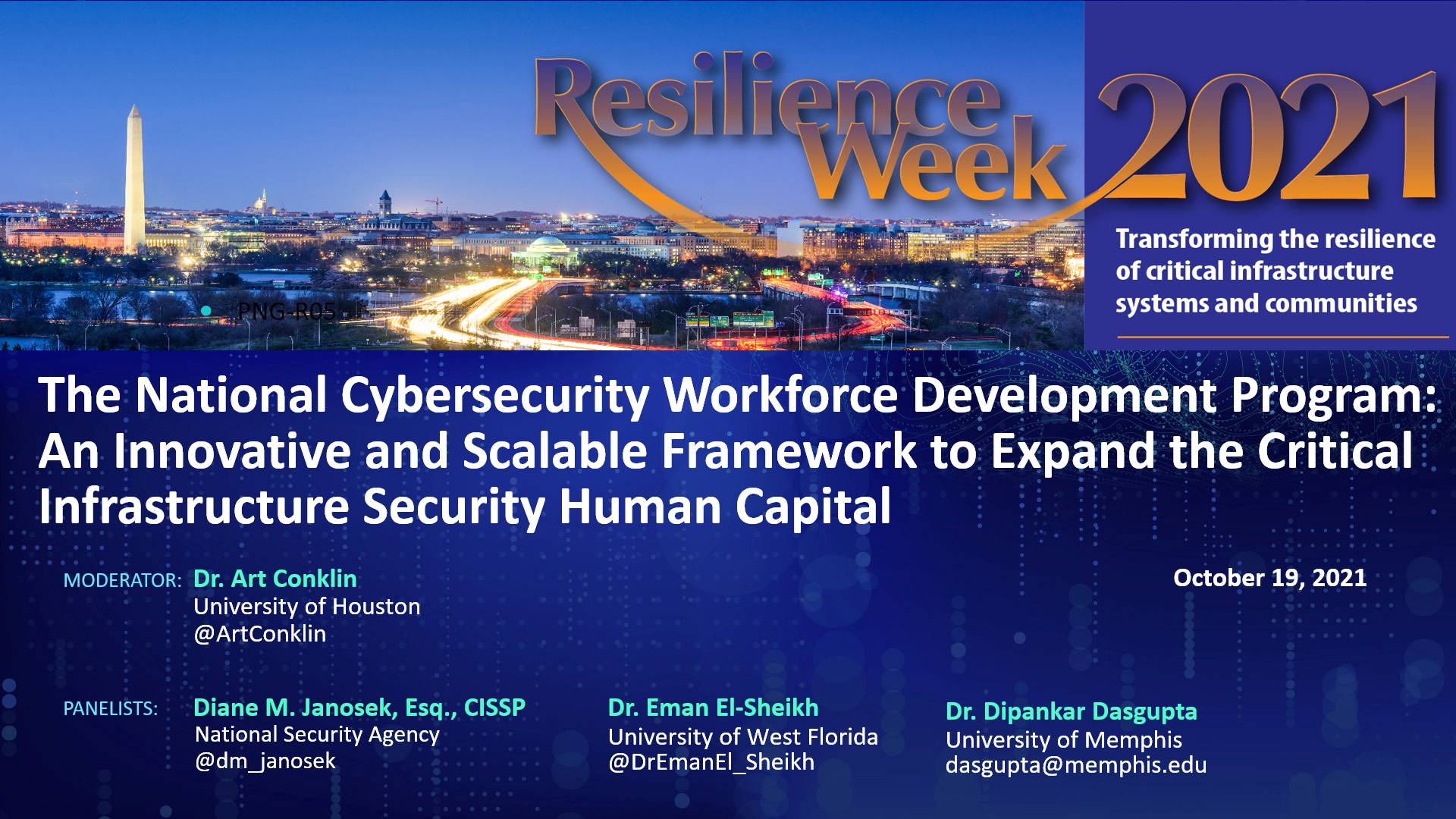
Dr. Dipankar Dasgupta, Hill Professor in Cybersecurity and Director of the Center for Information Assurance at the University of Memphis, will be a panelist for the workshop on "The National Cybersecurity Workforce Development Program" on Tuesday, October 19th. Registration and more information can be found at the following link ... Read More>>
Adversarial Defense Research Work Presented in ICML-2021 Workshop
Dr. Dipankar Dasgupta, Hill Professor of Cybersecurity at the University of Memphis,
and Dr. Kishor Datta Gupta presented their research paper titled, "Who is Responsible
for Adversarial Defense", in "Challenges in Deploying and Monitoring ML System" ICML-2021 workshop on July 23rd, 2021.
Doctoral degree awarded for CfIA students
Two Ph.D. students, Subash Poudyal and Kishor Datta Gupta were awarded the doctoral
degree in the 2021 Summer Commencement. Subash is joining Walmart Global Tech as a
Senior Risk Specialist of Cybersecurity and Kishor is joining as a PostDoc at North
Carolina AT&T University. Read More >>
Southeast CAE Community Forum
Dr. Dipankar Dasgupta, Hill Professor of Cybersecurity at the University of Memphis,
was a guest speaker at the July 16, 2021 meeting of the Southeast CAE Community Forum. In addition to giving an overview of the current state of cybersecurity, he provided
information about research collaboration opportunities. His presentation was entitled
"Research-Driven Cybersecurity Education and Training".
Cybersecurity Training Grant Research Opportunities
A joint effort of Engineering Technology and Computer Science has been awarded a grant
from the Office of Naval Research to build a team for opportunities of existing Undergraduate
students capable of effectively conducting research studies in the area of cybersecurity,
pairing a variety of skills with organization and leadership. Read More >>
Cybersecurity Research / Training Workshop Funded by Navy ROTC
The University of Memphis, The Center for Information Assurance, and The ROTC Research
Students is conducting Cybersecurity Research / Training Workshop on August 10, 2021,
from 09:00 AM - 01:00 PM Central Time (US and Canada). The topic of the workshop is
“How to stay ahead of emerging threats and gain new tools, guidance, and insight for
ways to protect you and your privacy”. Please register here in advance for this webinar. After registering, you will receive a confirmation email
containing information about joining the webinar.
Cybersecurity Virtual Workshop by CFIA and Navy ROTC
The Center of Information Assurance (CFIA) and the Navy ROTC research students will
be hosting a virtual workshop for all University of Memphis students on April 17,
2021, from 9:00 AM – 1:00 PM Central Time (US and Canada). Register. Read More >>
CS Students Won 1st and 2nd Place in 33rd Annual Student Research Forum
Computer science students Mazharul Hossain and Subash Poudyal won first and second
place respectively in the 33rd Annual Student Research for the Math and Computer Sciences
category. Mazharul's research topic was "Building Indoor Point Cloud Datasets with
Object Annotation for Public Safety”. Subash's research topic "Forensic Analysis of
Crypto Ransomware using Hybrid Multi-level Profiling Approach" was focused on proposing
a novel strategy for malware detection. Cybercriminals are constantly changing their
attack strategy and security checkpoints often miss catching them. "It is possible
to capture malware even if they bypass one or more checkpoints" says Subash.
University of Memphis Celebrates Patents Worldwide
The Office of Technology Transfer (OTT) within the Division of Research and Innovation
has received several notifications of issued or allowed patents centered on two separate
technologies. The first notice was a U.S. patent allowance focused on cybersecurity
from the U.S. Patent and Trademark Office. Read More >>
Cybersecurity Research Training Workshop
The University of Memphis and The Center for Information Assurance is conducting Cybersecurity
Research / Training Workshop on March 27, 2021, from 09:00 AM - 01:00 PM Central Time
(US and Canada). The topic of the workshop is “How to stay ahead of emerging threats
and gain new tools, guidance, and insight for ways to protect you and your privacy”.
Cybersecurity courses released for online access
Two new online courses ("Understanding Social Engineering Attacks" and "Mobile Device
Security and Privacy") concerning Cybersecurity have been developed by The Center
for Information Assurance at the University of Memphis and are available for access
online. These courses are funded by DHS/FEMA and are offered to the public at no charge.
Please see the flyer for more details: Understanding Social Engineering Attacks and Mobile Device Security and Privacy
2021 DoD Cyber Scholarship Program (CySP)
The Department of Defense is seeking rising junior and senior undergraduate (third
and fourth year) and graduate/doctoral students who are interested in full-ride scholarships
for concentrated studies in information assurance. Read More >>
Cybersecurity paid internship program by NSA and OSBP
The National Security Agency (NSA) and Department of Defense’s Office of Small Business
Program (OSBP) in partnership with the Maryland Innovation & Security Institute (MISI)
and the GBC MISI Academy seek applicants for a 6-week paid internship program in cybersecurity. Read More >>
Cybersecurity openings at NSA
NSA's Cybersecurity mission is hiring! Read More >>
Innovation Award presented to Prof. Dasgupta
Prof. Dipankar Dasgupta was recently presented with an innovation award for his work in multi-factor authentication
at the INNOVATE IT 2020 Conference. Read More >>
Events
Friday
|
A Virtual AI Enhanced IoT Security Workshop By: North Carolina A&T State University |
|
Thursday
|
Cybersecurity Education for Critical Infrastructure Protection By: The Citadel College |
|
Friday
|
2023 Cyber Resilient EV Charging Station & Critical Infrastructure Workshop By: The University of Memphis CfIA |
|
Wednesday
|
2023 Cyber Ambassador Tech Camp By: The University of Memphis |
|
Friday
|
12th Annual Mid-South Cybersecurity Summit 2022 By: The University of Memphis CfIA |
|
Friday
|
IoT Security Workshop By: North Carolina A&T State University and The University of Memphis CfIA |
|
Friday
|
The 6th annual National Cybersecurity Virtual Career Fair By: The National Cybersecurity Training and Education (NCyTE) Center and the CAE in
Cybersecurity Community |
|
Tuesday
|
Cybersecurity Research / Training (In-Person) Workshop By: The University of Memphis and The Center for Information Assurance |
|
Thursday
|
FBI Special Agent - Scott Augenbaum By: The Cyber Tigers, The University of Memphis, and The Center for Information Assurance |
|
Sat
|
Cybersecurity Research / Training Workshop By: The University of Memphis and The Center for Information Assurance |
|
Friday
|
Cybersecurity for Critical Infrastructure Workshop By: The University of Memphis, The Center for Information Assurance |
|
Sat
|
Cybersecurity Research / Training Workshop By: The University of Memphis, The Center for Information Assurance, and The ROTC
Research Students |
|
Friday
|
Smart Grid Security Workshop By: The University of Memphis, The Center for Information Assurance |
|
Sat
|
Cybersecurity Research / Training Workshop By: The University of Memphis, The Center for Information Assurance, and The ROTC
Research Students |
|
Registration August 23-October 8
|
NCL Competition Fall 2021 Season
The National Cyber League (NCL) is a cybersecurity competition that prepares student for a cyber career. In the NCL games, students work to solve... Read More>> |
|